
How Do Mystery Boxes Work? Odds, Expected Value and Fairness
Disclosure: Loot Boxes earns commissions from some links on this site and has a commercial relationship with MrLoot, which we promote. Read how we make money and how we review.

So how do mystery boxes work, really? Strip away the flashy animations and a box mystery is a weighted random draw with a price tag. You pay, the site draws one prize from the box's list of items and odds, and you ship it, swap it back for site credit or, on some sites, take its value in crypto. The interesting part is the maths underneath. Once you understand odds, expected value, sell back values and provably fair, you can see what you are really paying for before you open mystery box number one.
Key takeaways
- A mystery box is a weighted random draw. Every item has a drop chance, the chances add up to 100 percent, and the headline prize is usually the longest shot.
- Expected value is the average value you get back per box over many opens. It changes from box to box, and you can work it out from the published odds and item values. We have not found an independent study that measures it across sites.
- The gap between the price and the expected value is the house edge. It is how these sites make money.
- What you can sell a prize back for can be lower than its listed value, and none of the seven sites whose terms we checked publishes a fixed sell back rate.
- Provably fair lets you check that a result was not changed after the site committed to it. It does not show that the odds are generous, that prizes are fairly valued or that a site pays out.
What is a mystery box?
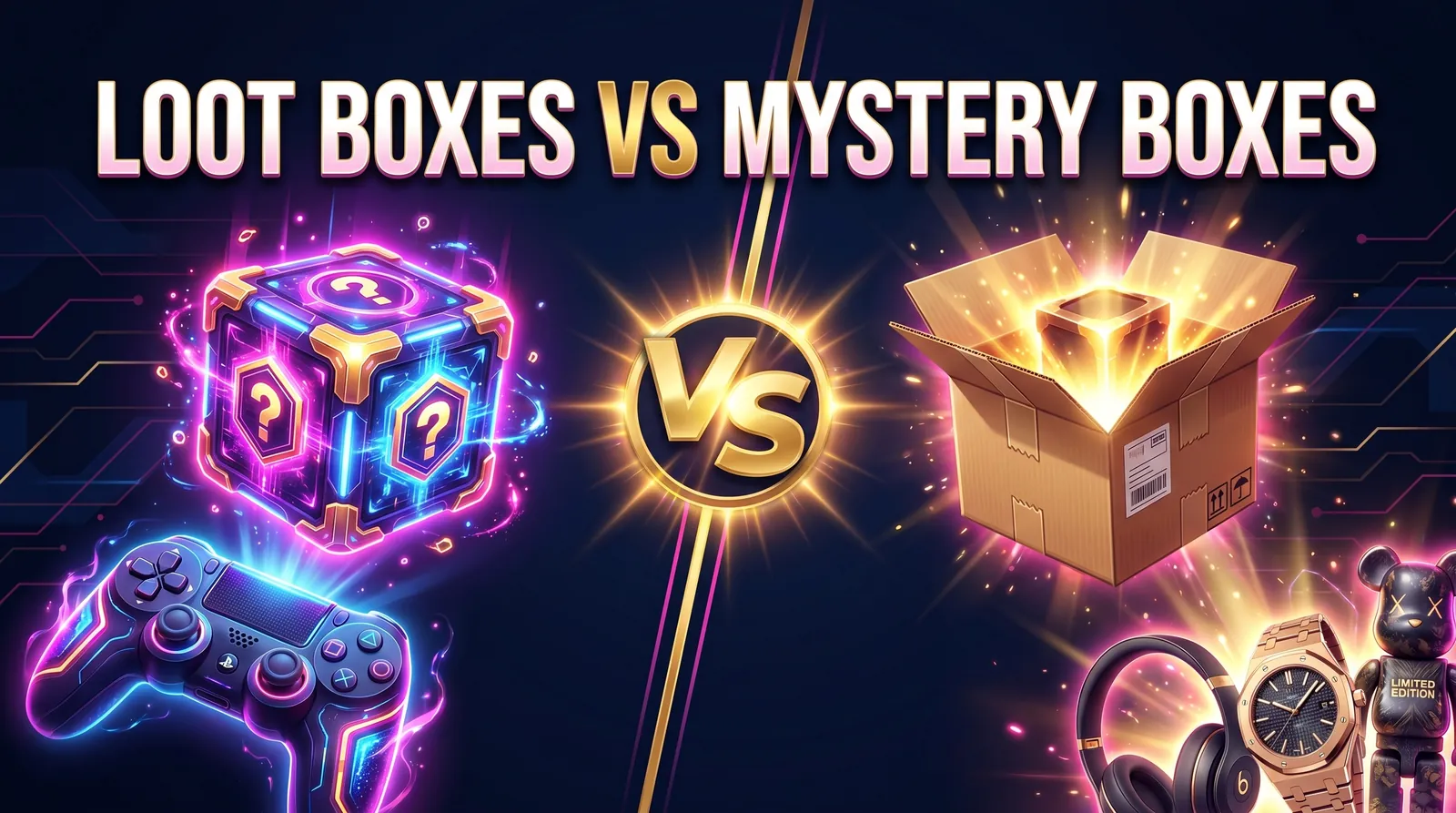
A mystery box is a sealed selection of possible prizes you buy without knowing which one you will get. Whether a listing calls it a mystery box, a box mystery or a digital loot box, the mechanic is the same. You can read how the digital and physical versions differ in our piece on loot boxes vs mystery boxes.
On the sites we cover there is one more layer worth knowing about before you start. On all seven platforms whose terms and help pages we checked on 23 Sep 2026, the money you deposit becomes site credit that you cannot simply withdraw again. It is there to be spent on boxes. What you can take out is the value of what you win: you ship the item, swap it back for credit or, where the site offers it, take a crypto payout. Refunds of unused credit, where offered at all, are limited and often at the site's discretion. Our mystery box site directory sets out the rules site by site, with links to each site's terms.
How mystery box odds work
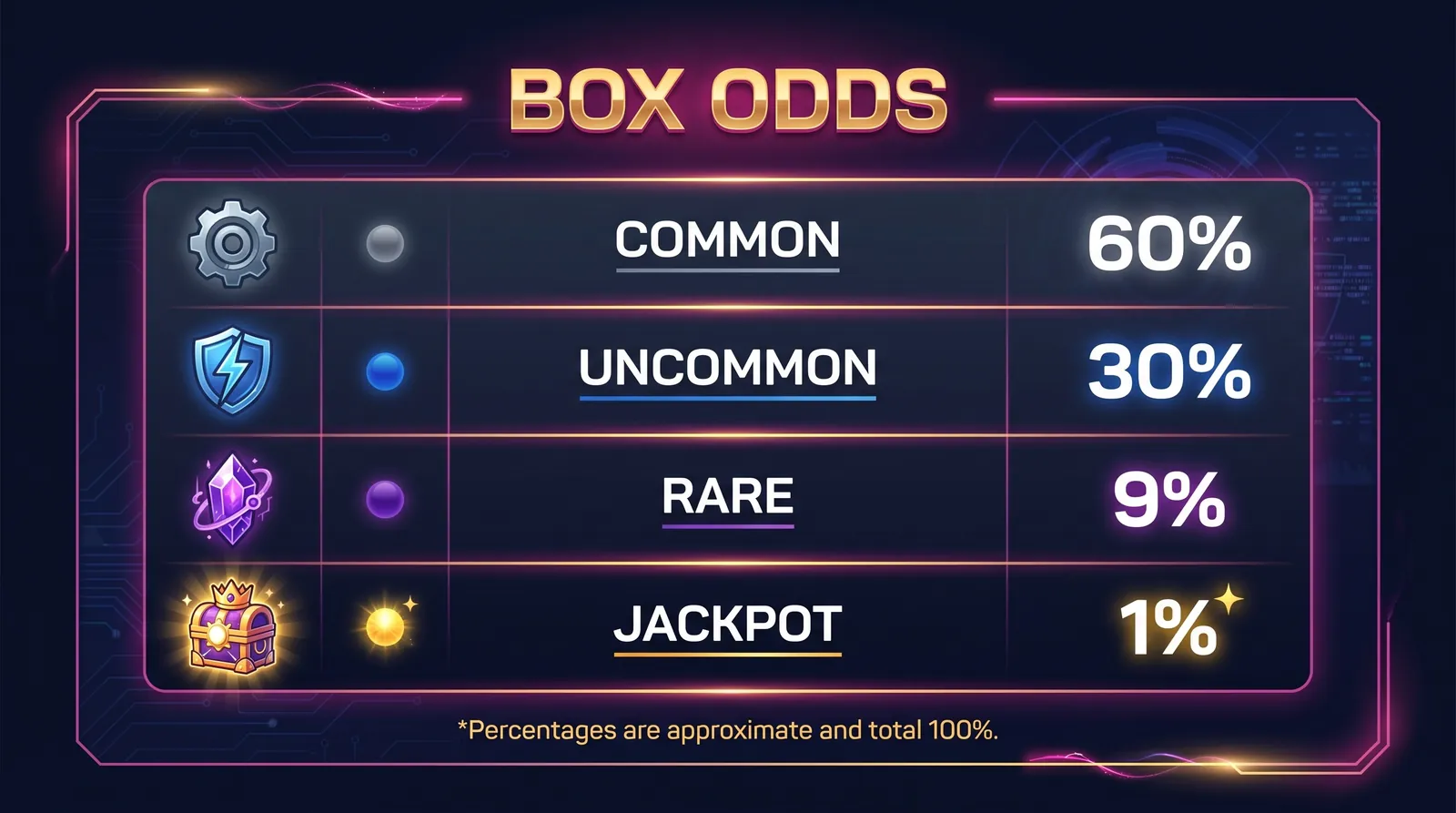
Every box has a prize pool, and every item in that pool has a drop chance. Take an invented example: 60 percent common filler, 30 percent mid tier, 9 percent good stuff and 1 percent jackpot. Add the chances up and they total 100 percent. The headline prize is usually the longest shot, which is exactly why it is the one splashed across the banner.
Real boxes make the point even more sharply. HypeDrop's cheapest box in its North American store, Tight Budget, cost $0.16 when we read its box page on 23 Sep 2026. Among its items it listed a $200 Steam gift card at 0.0001 percent, one chance in a million, next to a $0.06 voucher at about 60 percent and a $0.25 voucher at about 40 percent. Prices and odds change, so treat that as a snapshot.
Behind the screen, sites turn those percentages into ranges of ticket numbers. EmpireDrop's box pages, for example, give every item a range of tickets out of 10,000,000 in proportion to its chance, and Packdraw's fairness page describes tickets from 1 to 1,000,000. The draw produces one number, and the item whose range contains it is your prize. The spinning reel is decoration. Lootbox's terms warn that the animation may not always show the item you actually won, because the result is set by the algorithm, and the terms of MrLoot, our commercial partner, say its animations do not necessarily depict every possible prize.
In our view, reputable sites publish these rates, and a site that hides them has told you something before you have spent a penny. Some places now require it. South Korea has required game companies to disclose loot box probabilities since 22 March 2024, according to law firm Kim & Chang, and in June 2023 China's market regulator told blind box sellers to publish the value of the contents, the draw rules and the probabilities, Xinhua reported. We found no general legal duty for mystery box websites to publish odds in the UK or the US.
Expected value, the number that actually matters
Expected value, or EV, is the average you would get back per box if you opened it thousands of times. Multiply each prize's value by its chance, add the results, and you have the EV. Here is the invented box from the illustration, with a $10 price and made up prize values. It is the same example our mystery box odds calculator loads.
| Tier and item | Value | Odds | Value times odds |
|---|---|---|---|
| Common: sticker pack | $0.50 | 60% | $0.30 |
| Uncommon: wireless earbuds | $8.00 | 30% | $2.40 |
| Rare: smartwatch | $40.00 | 9% | $3.60 |
| Jackpot: games console | $300.00 | 1% | $3.00 |
Add up the last column and the EV is $9.30, a 93 percent return. That sounds close to break even, but look at the odds. The sticker pack and the earbuds are both worth less than the $10 price, and together they come up 90 percent of the time, so nine opens in ten lose money. The average only looks decent because a rare console pulls it up. A high EV does not mean you are likely to win.
Real boxes vary. EV changes from box to box and site to site, and it can only be worked out from that box's published odds and item values. We have not found an independent study that measures it across mystery box sites, and the figures quoted around the web disagree widely, so check each box yourself.
Some players believe cheaper boxes return a higher percentage than big trophy boxes. We have not seen data that proves it, so compare the EV of each box before you open it. What a cheap box does do is limit what each open costs, which is why, in our view, a cheap mystery box is a sensible place to learn the ropes.
The house edge in one sentence
The gap between the price and the expected value is the house edge, and it is how these sites make money. In the example above, a $10 box with an EV of $9.30 leaves the house 70 cents per open on average, a 7 percent edge. It works much like the edge on a casino game: you will not notice it on any single open, but it adds up over many. If a box page does not state a return figure, you can work it out yourself from its odds and values. Whether a site publishes the odds you need for that is one of the checks in our comparison of the best mystery box websites.
Our view: expect to pay for the entertainment over time. Treat a mystery box as paid fun with a budget you can afford to lose, not as an investment, and the maths will not catch you out.
Keep, ship or sell back: why exchange values matter
Once a prize lands you usually get three options. Ship the physical item to your door, sell it back to the site for credit you can spend on more boxes or, on some sites, take its value in crypto. Here is the catch the EV example skipped: which value goes into the sum.
The value printed next to a prize is set by the site. MrLoot's terms, for example, say every opening gives a prize whose assigned value is at least the price of the box, but that assigned value is MrLoot's own fulfilment price, not a market price, and trading the prize back happens at a displayed exchange value that may be lower. Other sites value a prize when you exchange it, not when you win it, so the number can move after you open the box.
That changes the maths. If the invented box above only let you sell items back at 70 percent of their listed value (a made up rate for this example), its EV on a sell back basis would fall from $9.30 to $6.51, and the house edge would rise from 7 to about 35 percent. When you use the calculator, enter the value you could actually get back, not the sticker value.
| Site | Selling back or exchanging a prize | Source |
|---|---|---|
| Boxed.gg | Any card can be sold back for its gem value (1 gem is about one cent) at any time, and newly pulled cards get seven days of price protection. No percentage is stated. | Boxed.gg help centre |
| EmpireDrop | Prizes are credited at the value EmpireDrop displays. You can spend that value on the site or withdraw it in crypto at a value EmpireDrop sets from the market price or its own valuation. | EmpireDrop terms |
| HypeDrop | Items can be exchanged for credits or other goods. Every exchange carries a fee shown at the point of exchange, and you cannot sell an item back for more than the value you got it at. Crypto payouts of item value start at $15 with a 2 percent processing fee. | HypeDrop terms and FAQ |
| Lootbox | Items are exchanged for credits at their value when you exchange, not when you won, and values may be updated daily. Exchanges to crypto are made less exchange fees. | Lootbox terms |
| MrLoot (our commercial partner) | Prizes are traded back for Looties at the exchange value displayed at the time, which the terms say may be lower than the prize's assigned value. Exchanged Looties can only be spent on MrLoot. | MrLoot terms |
| Packdraw | Items can be sold for balance or swapped on the Exchange page, and are valued at the moment you redeem or exchange them. No percentage is stated. | Packdraw Exchange page (archived) |
| Rillabox | Items are exchanged for site credits at the rate specified for each item. The terms add that an item you do not order for delivery within 24 hours may be resold to the company automatically. | Rillabox terms |
Fees come off the top as well. The terms we read put import duties on the buyer when an item ships across borders, and crypto payouts can carry network or processing fees, such as HypeDrop's 2 percent. The calculator ignores these, so your real return is lower still.
Provably fair, explained without the headache
Provably fair is how a good site proves it did not move the goalposts after you clicked. Here is the short version. Before your spin, the site generates a secret server seed and shows you its hashed fingerprint. You add your own client seed, and a nonce, a simple counter, joins the mix. When you open the box, those three ingredients decide the result. Afterwards the site reveals the original server seed, and you can hash it yourself to check it matches the fingerprint you were shown earlier. If it matches, the outcome was locked in before you played. Verifying one small spin takes a minute and tells you more than a hundred glowing reviews.

Keep, ship or sell back?
Once a prize lands you usually get three options. Keep it as account balance or credit, ship the physical item to your door, or sell it back to the site for value you can roll into another box or withdraw. Sell back values are not always generous, so check them. The cleanest sites also let you cash out winnings quickly, which is the whole point of playing somewhere trustworthy in the first place.
See the theory in a real site
MrLoot provides a colourful catalogue for exploring how themes and outcomes are presented. We like the visual organisation, but its terms distinguish nonwithdrawable Looties, nonredeemable XP and won products. The review and value guide explain why assigned platform value is different from money received.
Read the MrLoot reviewHow to open one with your eyes open
Pick a site that publishes odds and supports provably fair. Set a budget you are happy to lose. Start with a cheap box, verify a spin, and take a small withdrawal so you know the cashout works. That is the entire smart player routine, and we lay it out step by step in our guide to opening a mystery box online.
Frequently asked questions
How do mystery boxes work?
You buy a box, the site runs a weighted random draw against a published list of items and odds, and you keep, ship or sell back what you win. Provably fair sites let you verify the draw was set before you clicked open.
What is the expected value of a mystery box?
It is the average return per box over many opens, usually between 30 and 70 percent of the price. Cheaper boxes often return a higher percentage than premium ones.
What does provably fair mean?
The site commits to the result before you spin by showing a hashed server seed. Your client seed and a nonce are mixed in, and afterwards you can hash everything yourself to confirm nothing changed.
Are mystery boxes worth it?
As entertainment, they can be, if you set a budget and expect to pay the house edge over time. As an investment, no. Treat the fun as the product and you will play sensibly.