

Mystery Box Value: Retail, Sell Back and Real Returns
Disclosure: Loot Boxes earns commissions from some links on this site and has a commercial relationship with MrLoot, which we promote. Read how we make money and how we review.
You reveal an item labelled $100. Then the exchange button offers $65 in site credit. Before calling either number your return, ask what each number measures. Mystery box prize value, sell back value and money you could actually recover are not interchangeable.
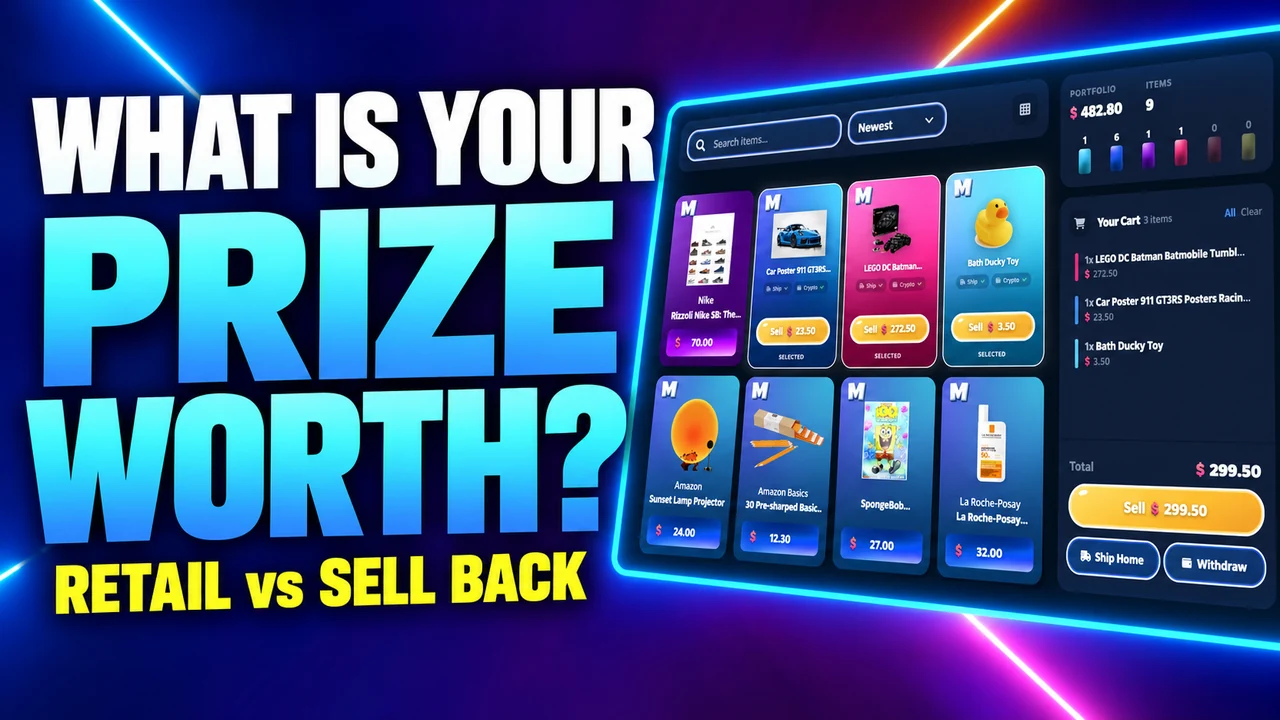
One item can have four different values
A retailer's asking price measures what that seller wants to charge. A platform's assigned value describes its own valuation. An exchange quote states the credit it offers for the item. A resale estimate describes what a buyer elsewhere might pay you, after considering condition and demand. All four can differ without the difference being visible in the reveal animation.
| Value type | Useful for | Important limitation |
|---|---|---|
| Assigned platform value | Reading the result as displayed | May differ from external prices |
| Retail price | Comparing the exact product with a direct purchase | An asking price is not a resale offer |
| Exchange credit | Seeing what another site purchase would cost | Credit may stay on the platform |
| Net redemption value | Comparing an available settlement after fees | Depends on eligibility and the current quote |
A worked example without the marketing labels
Consider a fictional item. Its assigned value is $100, a normal shop lists the same model for $72, the exchange button offers 65 credits, and an eligible settlement would provide $58 after its quoted fees. These numbers answer different questions.
If you want the physical item, compare its delivery costs and condition with the $72 direct purchase. If you want to leave the platform, investigate the $58 route and its conditions. If you want to use 65 credits for more openings, recognise that you are buying further uncertain outcomes.
Suppose you originally spent $80. Receiving $58 would leave you $22 below that spending before any later costs. A $100 label does not turn that into a $20 gain. Keep your spending history separate from the operator's product labels.

Why the unit matters on real sites
Boxed.gg's gem guide describes gems as its internal currency rather than a cash balance. If an item is exchanged for gems, you should evaluate that as an option for further platform use, not silently count it as cash received.
MrLoot's Exchange terms likewise distinguish the exchange value from the assigned product value. We appreciate an interface that lets you inspect the available options together; our MrLoot review gives the wider context. Compare the final quote, not just the attractive item card.
Expected value needs the right inputs
Expected value is the sum of each outcome's probability multiplied by its value. The arithmetic cannot tell whether you chose meaningful values. Using retail labels in one box and net settlement quotes in another produces an apples to oranges comparison.
For a simple fictional box costing $10, imagine an 80% chance of a $2 net outcome and a 20% chance of a $30 net outcome. The expected net outcome is $7.60: 0.8 × $2 plus 0.2 × $30. The expected difference from the opening cost is minus $2.40. That is a long run average under the example's assumptions, not a prediction for your next opening.
Try the odds calculator with one consistent value basis. If some outcomes cannot be redeemed in the same way, disclose the limitation instead of presenting an exact looking return percentage.
Condition and timing can change the comparison
Check model numbers, storage capacity, region, size, card grade, packaging and condition. A sealed product is not automatically comparable with a used listing. A sold listing can be more informative than an ambitious asking price, but it still does not promise you a buyer.
Record the date of every comparison. A quote available when you reveal an item may differ from the quote offered when you later exchange it. If you are uncertain, pause and save the current options before taking an irreversible step.
Choose an outcome before recycling the balance
It is easy to treat returned credit as house money. It still has a use you would give up by spending it again. Decide whether your aim is to receive the product, use eligible settlement, or continue for entertainment. Do not let a bright exchange button make the decision for you.
Read how withdrawals work before assuming the credit can leave later. If a physical prize is appealing, use the shipping worksheet. Keeping those choices separate makes the numbers much easier to interpret.
Frequently asked questions
Why is my sell back quote lower than the item value?
The figures may measure different things, such as an assigned fulfilment value and an exchange credit offer. Compare the definitions and exact current quote.
Is site credit the same as a cash return?
No. Credit can be restricted to spending on the site. Its amount should not be added to cash received as if the units were identical.
Can I calculate expected value using retail prices?
You can calculate an average of those prices, but it will not establish your expected cash return. Use values that match the question and explain any uncertain inputs.